ISCT Blog
Sharing the latest innovations in the CT industry, as well as updates about our annual CT symposium and Education On-Demand program.
EDITOR:
Olga R Brook, MD, MBA, FSABI, FSIR, FSAR, FESGAR
Associate Professor, Harvard Medical School
Section Chief of Abdominal Radiology
Executive Vice Chair for Workforce Strategy and Talent Acquisition
Department of Radiology, Beth Israel Deaconess Medical Center, Boston, MA
Author: Dr. Shailendra Katwal, from Beth Israel Deaconess Medical Center
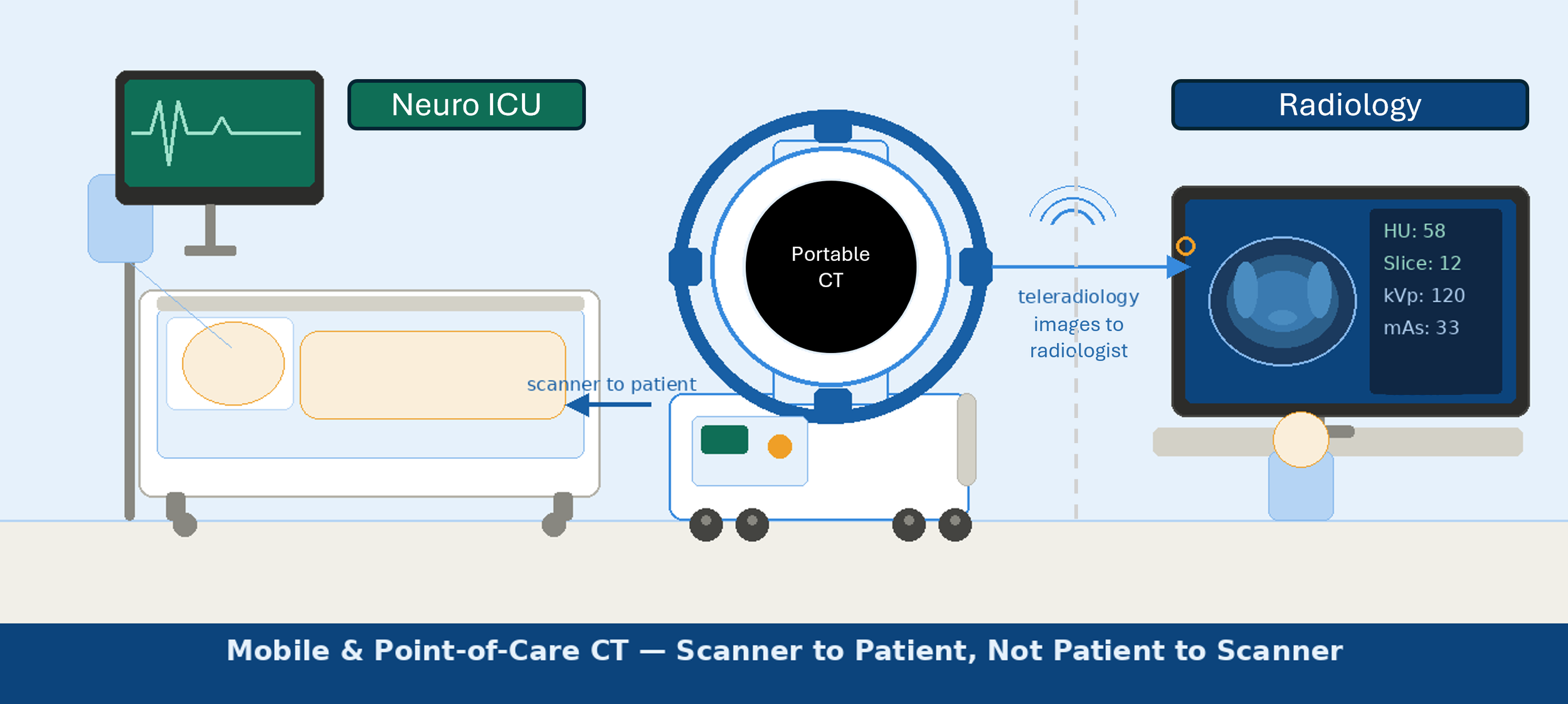
The Paradigm Shift: Scanner Goes to the Patient
The conventional model of CT imaging has always demanded that the patient travel to the scanner. For the majority of patients, this is unremarkable. For the critically ill — the ventilator-dependent ICU patient, the hemodynamically unstable trauma case, the acute stroke in the ambulance bay — this journey carries real clinical risk. Mobile and point-of-care (POC) CT inverts this model entirely, and as radiologists, it is essential we understand both its diagnostic capabilities and its limitations.
Photon-counting CT (PCCT) continues to emerge as one of the most significant advances in computed tomography in recent decades. While early development focused on detector physics and feasibility, recent progress has accelerated translation into clinical practice, with expanding applications across cardiovascular, neuro, musculoskeletal, and oncologic imaging.
Dose reduction in CT imaging has been a topic of considerable interest for the last 25 years. Many new technologies have been introduced into commercial systems that individually can reduce doses by approximately 10-40% each, depending on the diagnostic task and starting dose level. Over time, these technologies have not only reduced radiation doses but have allowed improvements in image quality that otherwise would have raised doses.
Despite being one of the most effective tools for early lung cancer detection, CT lung cancer screening remains underutilized across the United States. Even more than a decade after national guidelines recommended its use for high-risk populations, overall screening rates remain far below target.
One potential solution may be hiding in plain sight: meaningful, proactive conversations between clinicians and patients.
Celebrating 50 years of CT Imaging
by Cynthia McCollough, PhD[CHM1]
October 1 marks the 50th anniversary of the first computed tomography (CT) scan, which was performed in 1971 by radiologist James Ambrose at Atkinson Morley's Hospital in London, UK. Considered by physicians as the most significant medical advance of the 20th century, CT scans are used today to diagnose and guide the treatment of more than 90 million Americans each year.
The recent COVID-19 crisis has temporarily eliminated onsite educational opportunities for members of the medical community and beyond. At ISCT we understand that the pursuit of knowledge is paramount and we would like to thank our fellow medical and industry professionals with complimentary access to ISCT's OnDemand Chest CT course for the entire month of April.
For those in the medical field, COVID-19 is changing almost every area of life - from the way radiology departments operate to huge shifts in the daily practices of radiologists, technologists, and residents. It’s also changing the way that we approach CME.
This week we’re excited to announce our preliminary topics for ISCT 2020! We’re still in the early stages, so there’s a lot more to come as we bulk up our list of talks within each session and finalize our speakers for each slot, but here’s a look at some of the overarching session topics for our 2020 CT symposium:
A few years ago we launched ISCT Ondemand, a flexible e-learning option that allows members of the radiology community to continue their medical education on a timeline that works for their specific needs. We have dozens of accredited radiology courses available, each one focusing on a specific hot topic or organ system within CT. This week we’re highlighting our Neuro course, which provides an exciting, spirited update of the most important, high impact developments in CT neuroimaging.